


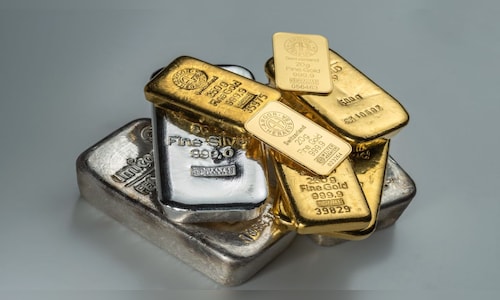
Gold prices traded largely steady on Thursday, December 18, as dovish signals from the US Federal Reserve bolstered market sentiment. However, a firm dollar capped potential gains ahead of crucial US inflation data. Meanwhile, silver continued to shine, hovering near all-time highs, driven by robust industrial demand, tightening supplies, and sustained investor interest.
Current Market Overview
In global markets, spot gold eased by 0.1% to $4,334.70 an ounce in early trade, following a more than 1% rise in the previous session. US gold futures slipped 0.2% to $4,365.40 an ounce. The dollar index maintained its recent gains after reaching a near one-week high, which limited the upside for dollar-denominated bullion.
Silver’s Stellar Performance
In contrast to gold, silver outperformed, with spot prices rising 0.3% to $66.48 an ounce after hitting a record $66.88 an ounce in the prior session. The metal has surged approximately 130% this year, significantly outpacing gold’s roughly 65% gain. This remarkable performance underscores silver’s appeal in the current market landscape.
Domestic Price Trends
In India, gold prices remained firm, with rates standing at ₹13,484 per gram for 24-carat gold, ₹12,360 for 22-carat, and ₹10,113 for 18-carat gold. Silver traded at ₹211 per gram, or ₹2,11,000 per kilogram, reflecting the strength in global prices.
Interest Rates and Economic Indicators
Markets are increasingly factoring in a supportive interest-rate environment for precious metals. The Federal Reserve recently delivered its third 25-basis-point cut of the year, and traders are now pricing in two additional rate cuts in 2026, despite the Fed’s dot plot indicating fewer reductions. Fed Governor Christopher Waller suggested that the central bank could continue cutting rates amid a cooling labor market, reinforcing expectations that non-yielding assets like gold and silver could benefit.
Recent US economic data has added to this perspective. The unemployment rate rose to 4.6% in November, the highest level since September 2021, while payrolls, retail sales, and housing indicators came in weaker than expected. Investors are now awaiting the November US Consumer Price Index data, followed by the Personal Consumption Expenditures inflation gauge for further insights.
Geopolitical Factors and Safe-Haven Demand
Geopolitical tensions have also contributed to safe-haven demand for bullion. Ongoing issues related to US sanctions on Venezuela and broader global uncertainties have kept investor interest in gold and silver intact, further supporting their prices.
Silver Supply Dynamics
Analysts point to tightening physical supply as a key driver for silver’s sharp rally. The metal has entered backwardation, with the gap between spot and futures prices widening to about 50–60 cents, signaling near-term supply constraints alongside speculative interest. Strong industrial demand, particularly from energy transition and manufacturing sectors, continues to underpin silver prices.
Some market participants speculate that silver could test the $70-per-ounce mark next year if rate cuts persist and demand remains robust. However, they caution that bouts of profit-taking could emerge following the recent rapid rise.
Market Outlook: Firm but Volatile
Market experts anticipate that gold will remain supported by global risk perceptions, central bank policy cues, and currency movements, with buyers likely to step in on dips. Silver, on the other hand, is expected to exhibit more volatility given the pace of recent gains, although its fundamentals remain constructive.
Technical analysis suggests that gold faces resistance around $4,355–$4,385 an ounce, with support near $4,245–$4,275. For silver, resistance is seen near $66.90–$67.75, while support is around $64.75–$65.40.
Conclusion
Overall, bullion markets are entering a data-heavy phase, with inflation readings and central bank decisions poised to determine whether the current momentum in gold and silver can sustain into the coming weeks. As investors navigate these complexities, the interplay of economic indicators, geopolitical tensions, and market sentiment will continue to shape the landscape for precious metals.
— With inputs from Reuters



 English