


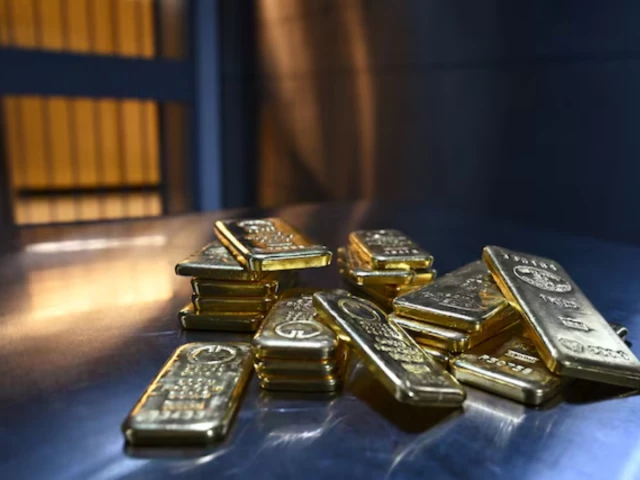
On January 28, 2026, gold bars of various values were securely stored in a safe deposit room in Munich, Germany, symbolizing the enduring allure of precious metals. As global markets fluctuate, the recent surge in gold and silver prices has captured the attention of investors and analysts alike. This article delves into the recent price movements, the factors influencing these changes, and the implications for both local and international markets.
Recent Price Movements
On Tuesday, following a three-day pause, gold and silver prices experienced a notable rebound. In the international bullion market, the price of gold surged by an impressive $240 per ounce, reaching $4,916. This dramatic increase reflects a broader trend of volatility that has characterized the precious metals market in recent weeks.
In Pakistan, the domestic market mirrored this trend. The price of gold per tola rose by Rs24,000, settling at Rs514,362, while the price per 10 grams increased by Rs20,576 to reach Rs440,982. Similarly, silver prices recorded significant gains, with the per tola rate climbing by Rs741 to Rs9,146 and the price per 10 grams increasing by Rs636 to Rs7,841.
Factors Driving the Surge
Several factors have contributed to the recent uptick in gold and silver prices. Spot gold climbed 5.8% to $4,935.56 an ounce by 0818 GMT, recovering from a low of $4,403.24 just a day prior. This volatility can be attributed to a combination of market sentiment, geopolitical tensions, and economic indicators.
The recent appointment of Kevin Warsh as the next chair of the US Federal Reserve has led to a reassessment of interest-rate expectations. Higher interest rates typically exert downward pressure on gold prices, as they increase the opportunity cost of holding non-yielding assets like gold. However, the uncertainty surrounding monetary policy has prompted investors to flock to gold as a safe haven.
The Impact of Margin Requirements
Another significant factor influencing the market has been the higher margin requirements imposed by the CME Group, a leading derivatives marketplace. These changes have created additional pressure on bullion and silver prices, leading to sharp declines in previous sessions. For instance, on Monday, gold prices in Pakistan fell below Rs500,000, with a steep decline of Rs21,500 per tola, settling at Rs490,362.
This volatility underscores the challenges facing investors in the precious metals market, as rapid fluctuations can lead to significant financial implications.
Silver’s Rollercoaster Ride
Silver has also experienced its share of ups and downs. After suffering its largest one-day loss on record, with a staggering 27% slump on Friday, silver prices rebounded by 10% to $87.40 an ounce on Tuesday. This recovery highlights the inherent volatility of the silver market, which often mirrors the movements of gold but can be more pronounced due to its smaller market size.
Broader Market Implications
The recent fluctuations in gold and silver prices have broader implications for investors and economies worldwide. Precious metals are often viewed as a hedge against inflation and currency devaluation, making them attractive during times of economic uncertainty. As inflationary pressures persist and geopolitical tensions rise, demand for gold and silver may continue to increase.
In addition, the performance of other metals has also been noteworthy. Spot platinum climbed 5.7% to $2,242.55 per ounce, while palladium rose by 5.3% to $1,811.39. These movements indicate a broader trend of recovery across the precious metals spectrum, driven by renewed investor interest.
Conclusion
The recent surge in gold and silver prices reflects a complex interplay of market dynamics, investor sentiment, and economic indicators. As the global economy navigates uncertainty, precious metals remain a focal point for investors seeking stability. The volatility witnessed in recent days serves as a reminder of the inherent risks and rewards associated with investing in these valuable assets. As we move forward, the precious metals market will undoubtedly continue to evolve, influenced by both domestic and international factors.



 English