


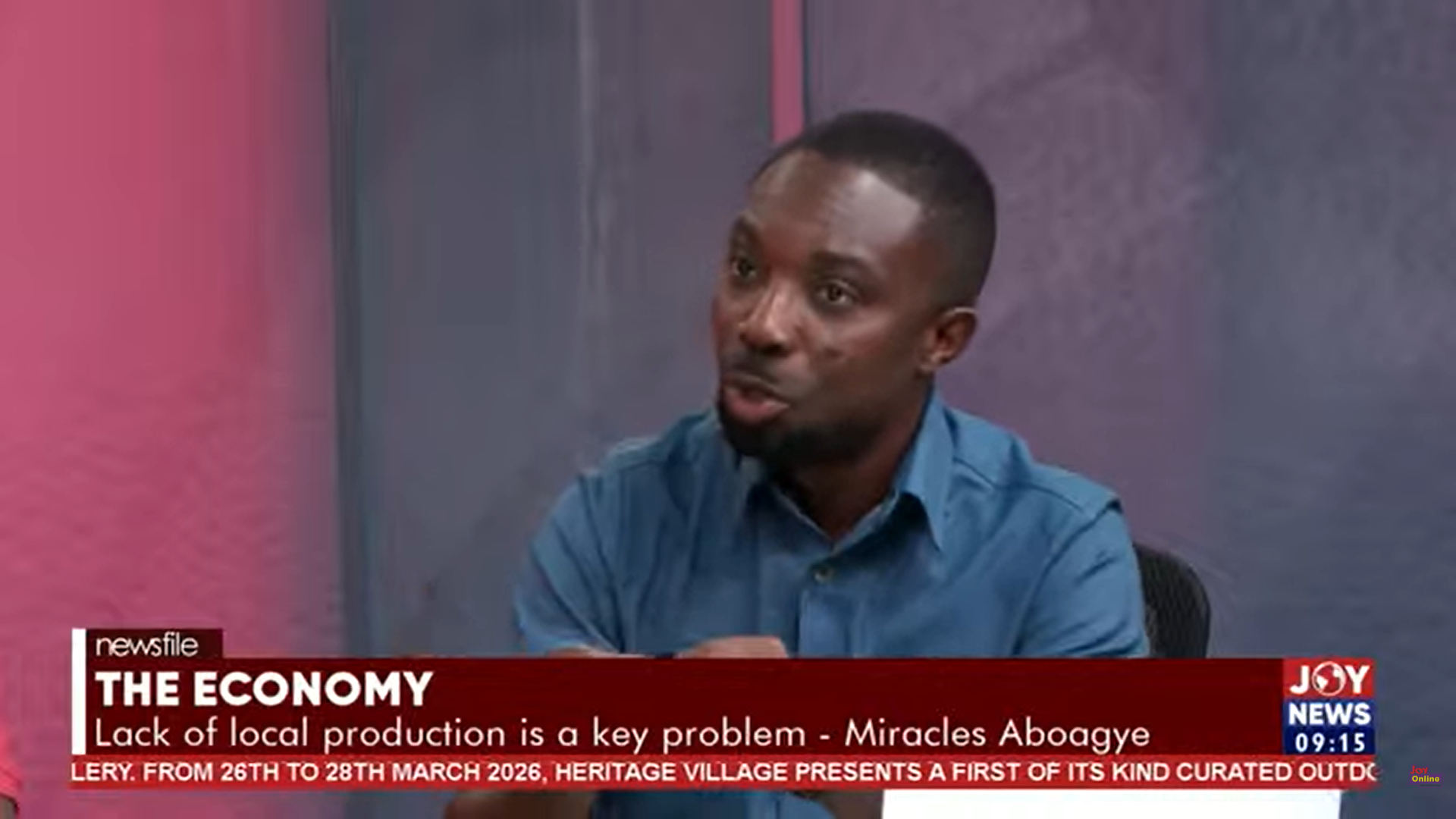
In a recent appearance on Newsfile, Dennis Miracles Aboagye, the Director of Communications for the Bawumia campaign, delivered a pointed critique of the Ghanaian government’s assertions regarding the resilience of the nation’s economy. His remarks come in the wake of claims made by President John Mahama, who has touted improvements in economic stability. Aboagye, however, argues that these claims are not substantiated by the realities on the ground.
The Structural Weakness of Ghana’s Economy
Aboagye’s central argument revolves around the notion that Ghana’s economy remains structurally weak, primarily due to its heavy dependence on imports. He emphasized that this reliance is a fundamental issue that has persisted over time. “The Ghanaian economy has one major problem — lack of local production,” he stated, underscoring the critical need for boosting domestic output.
This dependency on imports not only drains the economy but also exposes it to external shocks. Aboagye pointed out that a staggering 80% of spending in Ghana is directed towards imported goods, illustrating a concerning imbalance. “Any ten cedis you hold in this country, eight cedis goes back to the dollar,” he explained, highlighting the economic leakage that undermines local growth.
Aspirations vs. Reality
While the government has expressed intentions to stimulate domestic production and reduce import dependency, Aboagye questioned the tangible progress made in this regard. He urged the government to provide concrete evidence of policy implementations that have led to structural transformation. “Whilst the government is touting all these things, can they show us specifically what has been put in place?” he asked, suggesting that aspirations have not translated into reality.
Aboagye drew a clear distinction between the government’s claims of resilience and the actual state of the economy. “There is a difference between saying we are becoming resilient and saying we are resilient,” he cautioned, warning against overstating achievements without substantial backing.
External Influences and Economic Fragility
Aboagye further argued that Ghana’s recent macroeconomic improvements are largely contingent upon external factors, particularly the performance of gold in international markets. He noted that the gains observed in macroeconomic indicators are not solely the result of domestic policy but are heavily influenced by global commodity prices. “You are relying on external factors,” he stated, which undermines claims of a resilient economy.
The sensitivity of the Ghanaian economy to currency fluctuations was another point of concern for Aboagye. He warned that a significant depreciation of the cedi could have dire consequences, stating, “If we wake up tomorrow and the dollar spikes sharply, this economy is finished.” This fragility, he argued, is indicative of an economy that is far from resilient.
The Role of Government Policy
In his critique, Aboagye dismissed suggestions that government policy has significantly influenced fuel prices, asserting that global market forces play a dominant role. He emphasized that the government should refrain from making unsubstantiated claims about its impact on fuel prices, as the evidence suggests that only a small portion is within their control.
Aboagye’s remarks serve as a call for the government to focus on factual representations of the economic situation. “The President should take it easy. He has already won an election. He does not need to tell us things to make us happy. He just has to work,” he advised, urging a more grounded approach to economic communication.
A Path Forward: Building Domestic Capacity
Ultimately, Aboagye’s critique underscores the urgent need for Ghana to prioritize building its domestic productive capacity. He argued that without significant reforms aimed at reducing import dependency, the country will remain vulnerable to future economic shocks. “What he is telling us is not true. It is not factual,” he asserted, calling for a renewed focus on local production as the only credible path toward long-term economic strength.
In conclusion, Dennis Miracles Aboagye’s analysis presents a sobering perspective on Ghana’s economic landscape. While the government may celebrate certain macroeconomic indicators, the underlying structural weaknesses and external dependencies cannot be overlooked. As Ghana navigates its economic future, the emphasis must shift toward fostering local production and reducing reliance on imports to build a truly resilient economy.



 English