


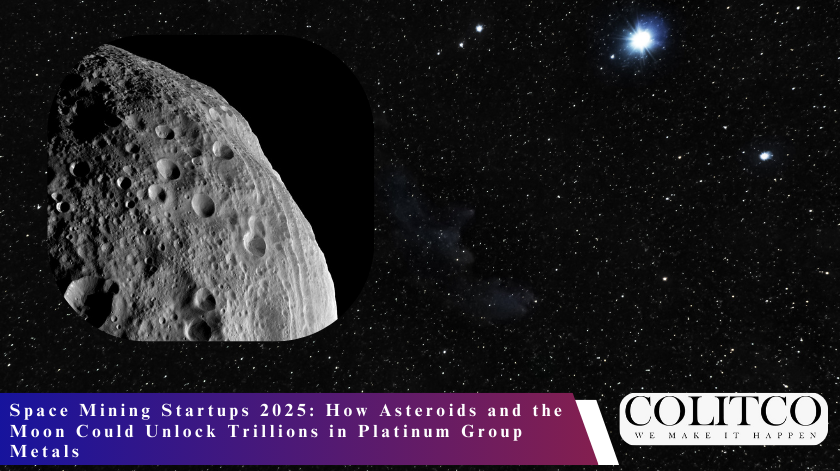
As we approach 2025, the concept of space mining is transitioning from the realm of science fiction to a tangible reality. Startups are emerging with ambitious plans to extract valuable resources from asteroids, the Moon, and beyond. Investors are increasingly drawn to the potential profits from selling platinum group metals, water, and rare earth elements. This burgeoning industry is not only capturing the attention of investors but also prompting technology firms and government agencies to prioritize space mining as a strategic initiative.
Why is Space Mining Attracting Serious Investment in 2025?
The year 2025 marks a pivotal moment for space mining, driven by the escalating demand for critical minerals. Platinum group metals (PGMs) such as platinum, palladium, rhodium, and iridium are essential for clean energy technologies, semiconductors, and hydrogen fuel systems. As terrestrial deposits become harder to mine, space mining offers a viable solution to alleviate the pressure on Earth’s resources.
Asteroids, particularly near-Earth ones, are believed to contain vast concentrations of PGMs. A single metallic asteroid could hold resources valued in the trillions of dollars. Additionally, water extracted from space can be converted into hydrogen and oxygen for rocket fuel, making it a valuable asset for future space missions.
Governments are also encouraging private participation in this sector. The United States, Luxembourg, and Japan have established regulatory frameworks to support space mining startups, providing clarity and fostering a growing acceptance of resource extraction beyond Earth.
What Will Space Mining Startups Actually Mine?
Space mining startups are focusing on high-value, low-volume materials rather than mass-producing common metals like iron or aluminum. The extraction of platinum group metals remains the primary target due to their compactness, high market value, and critical role in decarbonization technologies. The costs associated with extracting and transporting these metals can be justified by their potential returns.
Water mining is another crucial operation. Space agencies argue that it is more practical to extract water from lunar regolith or asteroids than to transport it from Earth. This water could sustain human habitats and power rockets, positioning space mining as a key player in the supply chain for deeper space exploration.
Rare earth elements, while not as scarce as PGMs, are vital for electronics, magnets, and batteries. Accessing extraterrestrial sources could diversify supply chains and reduce reliance on Earth-based monopolies.
Can Space Mining Startups Overcome Economic and Technical Barriers?
The challenges facing space mining are monumental. By 2025, startups must develop robotics capable of operating with minimal human intervention. This includes automatic extraction, on-site refining, and reliable power systems. Spacecraft must withstand extreme radiation, temperature fluctuations, and microgravity conditions.
Cost remains a significant hurdle. Although launch services have become cheaper due to reusable rockets, mining missions still entail exorbitant expenses. Startups must balance high initial investments against uncertain timelines for revenue generation. Breakthroughs in autonomous robotics, AI, and miniaturized sensors will be crucial in the coming years. Successful demonstration missions in the late 2020s could attract further investment for larger-scale operations in the 2030s.
How Does Regulation Affect Space Mining in 2025?
International law is lagging behind, leaving many questions unanswered. The Outer Space Treaty of 1967 designates outer space as a global commons, prohibiting sovereign claims but failing to clarify resource ownership. Startups need legal certainty to proceed with the sale of mined materials.
National laws are filling the gaps. The U.S. has enacted legislation allowing private parties to own extracted resources, with similar frameworks in Luxembourg and the UAE. However, a comprehensive global system is still lacking. Without a worldwide agreement, disputes may arise as large-scale mining begins. By 2028, diplomatic discussions could gain momentum, addressing licensing, taxation, and sustainability—key factors for investors and startups.
Who Are the Emerging Players in Space Mining Startups in 2025?
Several startups are positioning themselves as leaders in the space mining sector. U.S. companies are exploring asteroid prospecting missions, while European firms are focusing on resource mapping on the Moon. Japanese companies are collaborating with JAXA on sample return technologies, building expertise and fostering national industries.
Private companies often collaborate with government agencies, which provide launch capacity, mission data, and orbital support. Contracts with NASA or ESA can facilitate innovations and reduce risks. Startups are also attracting venture capital, gaining exposure to cutting-edge technologies.
The ecosystem surrounding space mining is expanding, with universities, aerospace suppliers, and robotics companies contributing to its growth. This collaborative approach mirrors the early days of commercial spaceflight, where partnerships significantly altered costs and timelines.
What Is the Outlook for Space Mining Beyond 2025?
The next three years will be critical for the space mining industry. Demonstration missions may attempt to extract water by 2028 or recover small amounts of metal from near-Earth asteroids. Success in these endeavors would validate decades of planning, while failure could delay progress but not halt it.
The global market for platinum group metals continues to thrive, and investors believe that space mining could reshape supply chains. Long-term forecasts suggest that pilot plants could be operational on the Moon or asteroids by the 2030s, with large-scale commercial extraction potentially beginning in the 2040s.
While space mining startups are still in their infancy, the momentum is undeniable. With Earth’s resources becoming increasingly scarce and demand rising, outer space is emerging as the final frontier for mining.
FAQs
Q1. What are the space mining startups of 2025?
These companies are actively working to extract resources from space, including metals and water.
Q2. Why are platinum group metals so vital for space mining?
PGMs are rare and essential for clean technologies, commanding high prices in global markets.
Q3. How soon can space mining be profitable?
Proof-of-concept missions are expected within this decade, with significant profits anticipated by the 2030s or later.
Q4. Will space mining replace Earth mining?
No, space mining will complement Earth mining, which continues to supply critical minerals.
As we stand on the brink of this new frontier, the potential for space mining is vast, promising to revolutionize our approach to resource extraction and sustainability in the cosmos.


 English